Light, Angle, Repeat: The Unsung Craft of Professional Leg Photography
Photo: Christoph Braun, CC0, via Wikimedia Commons
There's a moment on every professional set — usually around the hundredth frame — when the photographer adjusts a light by two inches and the whole image transforms. The shin catches a highlight. The calf curve deepens into an actual shadow. Suddenly it's not a photo of legs; it's a photograph.
That difference is craft, not luck. And unlike most studio secrets, this one's teachable. We sat down with three working glamour and content photographers to break down how great leg imagery actually gets made.
Lighting Is Everything — Especially for Skin
"People think glamour lighting is about brightness," says a photographer who's shot campaigns for hosiery brands and independent creators alike. "It's the opposite. It's about controlled shadow. Legs are essentially a series of curves, and curves only read on camera when light rakes across them at an angle."
The standard setup is simpler than you'd guess: one large softbox or window positioned 45 degrees off-axis and slightly above the subject's knees, with a reflector on the opposite side to fill shadows softly. Hard, overhead light — the kind in every hotel bathroom — flattens the leg's natural lines and emphasizes texture. Raking side light does the reverse.
Skin tone matters here, too. Deeper skin tones benefit from a slightly closer, larger light source to preserve luminous highlights without blowing them out, while fairer skin often needs the light pulled back to avoid hot spots on the shins and knees. The universal rule: meter for the highlight, not the shadow.
Hosiery Is a Lighting Instrument
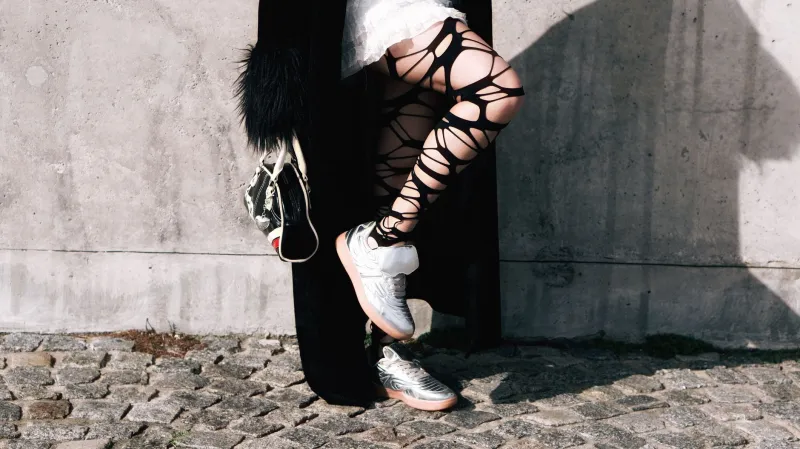
Here's a trick most fans never consider: professional stylists treat stockings and tights as lighting tools, not just wardrobe. A sheer 15-denier stocking diffuses light across the skin like a built-in soft-focus filter — which is exactly why classic Hollywood shot legends through veils and hosiery.
Denier changes everything. Ultra-sheer styles photograph with a subtle sheen that catches raking light beautifully. Opaque tights create clean graphic shapes and hold their color under studio strobes. And texture — fishnets, patterns, back seams — reads best with harder, more directional light that gives the texture something to catch.
Styling tip from the pros: match your hosiery finish to your light. Sheer plus soft light equals dreamy. Textured plus hard light equals editorial. Sheer plus hard light equals a hot spot on the shin and a ruined frame.
Posing: The Curves You Can't See From the Chair
Ask a model to "just sit naturally" and you'll get a photo of someone sitting. Ask for the classic leg-posing sequence and you get content.
The fundamentals: extend the toe (pointing the foot lengthens the entire leg line), create a bend somewhere (a straight leg is a dead leg on camera), and stagger the legs so one sits slightly forward of the other, which builds depth. Crossing at the knee angles the thigh's silhouette toward the lens. Reclining poses work best with the top leg slightly raised, letting light rake across the calf.
"I always tell new models: the camera sees the line, not the limb," one photographer told us. "Your job is to draw a beautiful line through the frame. Everything else is detail."
Editing Without Over-Editing
Post-production in this niche is about restraint. The pros' checklist: gentle skin smoothing at low opacity (never the plastic-blur look), a subtle dodge-and-burn on the leg's highlight line to enhance dimension, and color grading that keeps skin tones natural — warm neutrals for a classic look, cooler tones for editorial vibes.
The tell of amateur editing? Uniform blur. Real retouching preserves texture — the slight sheen on a knee, the weave of a stocking — while cleaning up only genuine distractions.
Start With What You Have
Every photographer we spoke with said the same thing to aspiring creators: don't wait for a studio. A north-facing window, a white bedsheet as a reflector, and a phone camera at knee height will outperform the most expensive ring light used badly. Learn to see light first. The gear can come later.
Great leg photography isn't magic. It's a window, an angle, and a hundred small decisions — made on purpose.